

There was a time when creators had no idea what was working. You'd post, watch the number tick up or down, and move on. The job was to make content and hope. If it flopped, you tried something else. If it didn't, you tried to do it again - usually without understanding why it worked.
That approach still works. If you're lucky. If the algorithm is generous. If a sound happens to be trending when you post. But luck isn't a content strategy, and it definitely isn't what gets you brand deals.
TikTok competitor analysis has become the discipline that separates creators who grow consistently from those who spike occasionally. And in 2026, with TikTok Shop, Instagram's in-app checkout, and brands evaluating creators on rolling performance rather than one-time virality, the margin between a creator with a process and one without has never been wider.
This guide is for creators who are serious about closing that gap.
Why Most TikTok Competitor Analysis Is a Waste of Time
You've probably done some version of this: you open a competitor's profile, scroll their top posts, make a mental note that they do "a lot of POV videos," and move on. Maybe you save a few videos. Maybe you build a spreadsheet that tracks their follower count weekly.
None of that is analysis. It's observation without hypotheses. And it changes nothing about what you post tomorrow.
Teams can spot a winning video but can't reliably reproduce the hook, tempo, or editing pattern. They copy the idea, not the context. That's why the replicated version almost always underperforms.
The second mistake is tracking the wrong metrics. Follower count is a lagging indicator - it tells you what happened weeks ago and explains nothing about causation. Even engagement rate, the most cited benchmark in competitor analysis, is useless in isolation.
A competitor averaging 4.2% engagement sounds impressive until you realize their comment section is mostly emoji reactions, their audience is mostly other creators, and their last brand collaboration post flopped. That 4.2% tells you nothing about whether their approach will work for you.
Key benchmarks to know:
- Average TikTok engagement rate: 2.5%
- Hook window that determines watch time: 3 seconds
- Window where engagement velocity matters: 48 hours
- Competitors worth tracking closely: 5–8
What actually predicts performance - and more importantly, whether your content earns brand attention - is engagement velocity in the first 24–48 hours, comment intent (do people ask "where do I buy this?"), and format consistency (has a competitor found a repeatable structure, or are they still experimenting?).
How to Actually Do TikTok Competitor Analysis
The framework is simple: Identify → Deconstruct → Quantify → Test → Scale. Every step produces something you can act on immediately - not a report, but a creative decision.
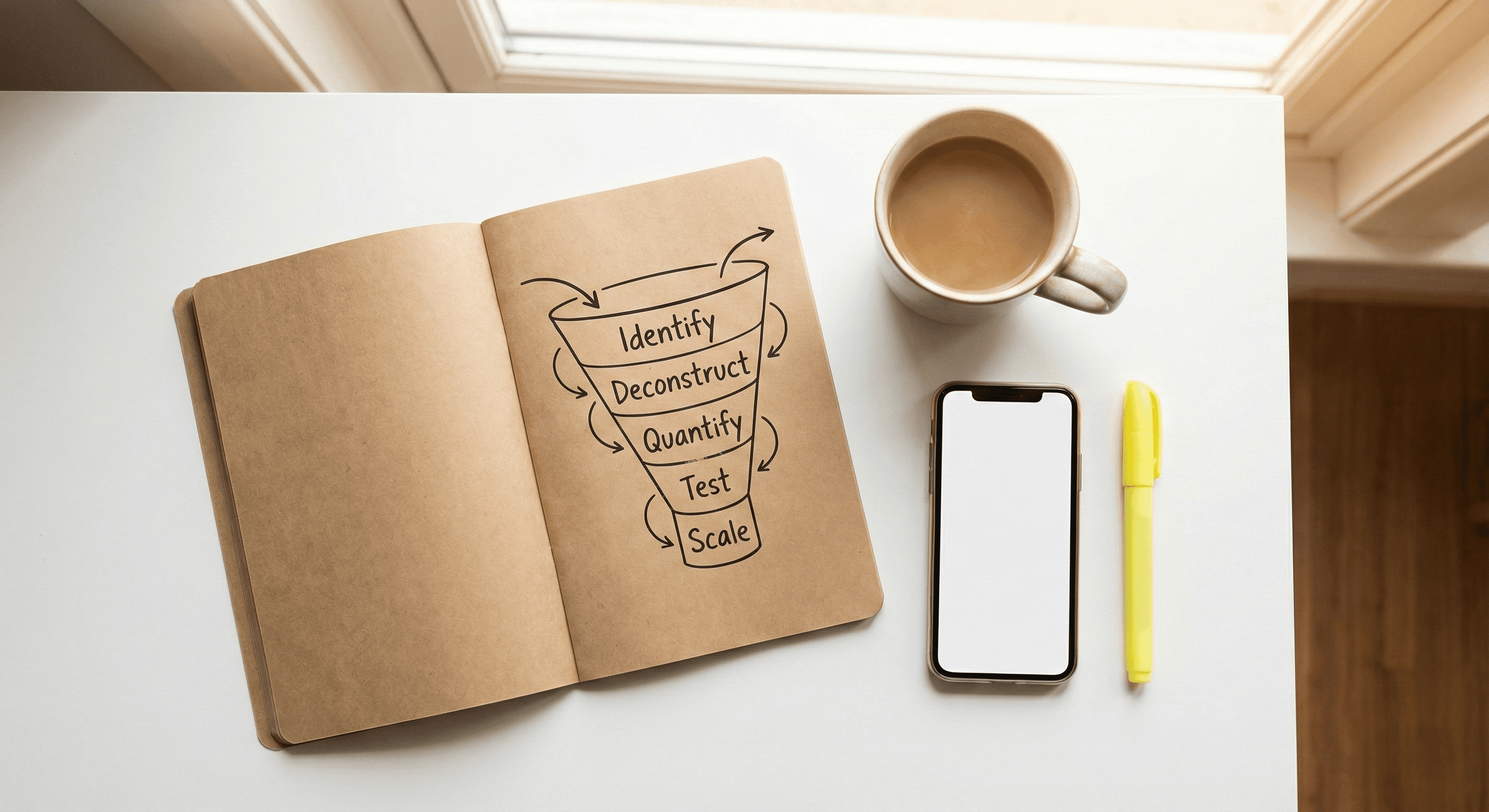
Step 1: Identify the right accounts (not just the big ones)
Pick 5–8 accounts. Two direct competitors posting similar content, two creators with overlapping audiences but different angles, and two aspirational accounts - bigger than you, operating in your space. Don't track more than that. Depth beats breadth at this stage.
Find them through niche hashtag searches, TikTok's "others also viewed" signals on competitor profiles, and Instagram's Explore page filtered by your content category. The goal isn't to find the most popular creators - it's to find the ones your target audience is already watching.
Step 2: Deconstruct - capture decisions, not just outcomes
For each post you audit, capture the structural decisions that produced the outcome, not just the outcome itself. What were the exact words of the hook? Did it open with a visual cut, a spoken line, or text overlay? What format was it - tutorial, POV, before/after, challenge? What sound was used and was it trending?
This is the level of detail most creators skip. They note "tutorial format" and call it done. That's a genre label, not a brief. You can't replicate what you don't understand.
The most underused intelligence source: Read the top 20 comments on a competitor's best post. Group them: social proof, objections, curiosity, and purchase intent signals ("link?", "where to buy?"). Those objections are your next video. Those curiosity questions are your next series. It's the cheapest market research you'll ever do.
Step 3: Quantify - measure what moves the needle
Track view-to-like ratio, not just views. Note posting cadence and timing. Flag posts where a product link, landing page, or consistent CTA suggests paid promotion - because organic benchmarks and paid-boosted benchmarks are not the same thing, and conflating them will mislead your hypotheses.
One post means nothing. You need a pattern across at least 10–15 posts before any metric is meaningful.
Step 4: Test - hypotheses, not hunches
Extract 3 micro-hypotheses from what you observed. Something specific: "Two jump cuts before the product reveal increases watch time past the 8-second mark." Then test each hypothesis with 3 videos. A/B against your baseline. Measure comment volume, watch time, and view-to-like ratio - not just total views.
This is where most competitor analysis frameworks break down. They stop at "observe and learn." The only output that matters is: did you change what you shipped?
Step 5: Scale - turn one win into a content engine
When a variant outperforms your baseline, build a 7-video series in that format. Batch-produce it. Standardize the editing template. Then convert the top performer into a paid booster with proper tracking - and take that performance data to your next brand pitch.
Instagram Competitor Analysis: Why You Can't Do TikTok in Isolation
Here's a mistake that costs creators real growth: treating TikTok and Instagram as separate strategies. They're not. Your audience moves between them. Brands evaluate you across both. And a format that's working for a competitor on one platform almost always tells you something valuable about the other.
But most creators are guessing at which platform deserves their energy. They post more where they feel comfortable, not where the data points. That's how you end up overinvesting in a channel that's plateaued while your competitor quietly builds on the one you're neglecting.
"The creators closing the most brand deals in 2026 aren't going viral - they're building consistent performance data across two platforms that brands can actually evaluate."

The practical answer is to run your TikTok competitor analysis and Instagram competitor analysis in parallel - same framework, same accounts where possible - and look for divergence. If a competitor's Reels are outperforming their TikToks, that's a signal about format or audience concentration worth investigating.
Turning Competitor Data Into Content - Without Creative Burnout
There's a specific frustration that hits creators after a good analysis session: you know what's working. You see the pattern clearly. You understand the hook structure, the sound choice, the CTA timing. And then you sit down to write your own version - and the blank page wins.
The gap between insight and execution is where most competitor research dies. You did the work, spotted the winning format, and then posted something entirely different because you ran out of creative energy before you ran out of ideas.
- Extract the hook pattern from your best competitor find - not the topic, the structure. "Did you know [counterintuitive claim]?" is a transferable template. Apply it to your niche.
- Build a format bank - a running doc of 10–15 proven formats with the structural notes captured from your audits. When you hit a blank page, you're choosing a format, not inventing one.
- Batch production beats daily inspiration. Schedule one content day where you produce 6–7 posts based on your current winning format. Posting one by one from scratch is how you get inconsistent.
- Treat your comment section as a content brief. The questions people ask are your next videos. The objections they raise are your next "myth busting" series. Your audience is already writing your editorial calendar.
How This Translates to More Brand Deals
Brand partnerships in 2026 are evaluated differently than they were two years ago. Brands have burned enough budget on creators with high follower counts and poor conversion rates. The new evaluation is more rigorous: rolling 30-day performance, average watch time, comment quality, and consistency of engagement across posts - not just your best video.

What competitor analysis does for your deal pipeline isn't magic - it's mechanical. Consistent formats produce predictable performance. Predictable performance produces a data story. A data story wins brand conversations that a follower count alone never could.
Increasingly, brands request "rolling 30-day performance data" and want to see consistent engagement - not a viral outlier. If your average watch time is 65% and your engagement rate has trended upward for 8 weeks, that closes deals. A single viral post doesn't. Competitor analysis helps you build exactly that trajectory - by testing formats with higher conversion rates and doubling down on what works before you pitch.
The secondary value is positioning. When you walk into a brand conversation knowing exactly what's working in your niche - which hooks are converting, which formats are underused, which audience segments are engaging - you sound like a strategist, not just a creator. That distinction matters in how brands structure compensation.
What's Different in 2026 - and What Competitors Are Getting Wrong
Every trend piece will tell you short-form video dominates. That's not insight - it's a headline. The more useful analysis is the second-order shifts that most competitors haven't caught up with yet.
TikTok's 25–44 expansion changes who you're competing for
TikTok's fastest-growing US demographic is now 25–44. The platform isn't a Gen Z specialty anymore - it's a full consumer channel. Creators still positioning their TikTok as "young energy" content are ceding ground with every post. When you analyze competitors, note whether they've adjusted messaging and CTA style for this broader audience.
Commerce integration is a gap most creators haven't closed
TikTok Shop and Instagram's in-app checkout are genuinely different conversion tools - closer to in-store impulse purchasing than traditional e-commerce links. Most creators are still using them as slightly-shorter swipe-up funnels. If competitors in your niche haven't launched LIVE shopping events and you have, that's a real gap to exploit. If they have and you haven't, that's the urgent thing to address before your next brand negotiation.
The algorithm rewards format recognition over one-off virality
Both TikTok and Instagram's discovery systems increasingly reward accounts that establish a recognizable format - a "content fingerprint" that the algorithm learns to serve. Consistent series outperform scattered viral attempts over any 90-day window. When auditing competitors, look for whether they're building a format that compounds, not just chasing whatever trend showed up yesterday.
Frequently Asked Questions
How do I do a TikTok competitor analysis?+
Start by identifying 5–8 competitors or aspirational creators in your niche. Track their top-performing posts and analyze hook structure, format type, audio choices, and CTA placement. Then measure engagement velocity in the first 24–48 hours, not just total likes. Use that data to form testable content hypotheses - specific things you'll test in your next 3 posts.
What metrics should I track for TikTok competitor analysis?+
Prioritize engagement velocity (first 24–48 hours), view-to-comment ratio, hook format and wording, posting cadence, and comment intent - specifically whether viewers are asking about purchasing, pricing, or links. Follower counts are lagging indicators and much less useful than real-time engagement patterns.
What's the best tool for tracking competitor content on TikTok and Instagram?+
For UGC creators managing multiple platforms, a cross-platform analytics tool centralizes TikTok and Instagram data in one dashboard - showing which hooks and formats drive engagement across both platforms simultaneously. Native analytics (TikTok Pro, Instagram Insights) work as a starting point, but they don't give you competitor visibility or cross-platform comparison.
How does competitor analysis help you land brand deals?+
Brands in 2026 evaluate creators on rolling performance data, not single viral posts. By analyzing what works in your niche and building consistent formats around it, you produce a performance story - trending engagement over 8+ weeks - that brand managers can use to justify investment. It also lets you speak strategically about your niche during pitches, which changes how you're perceived and compensated.
How often should I analyze competitors on TikTok?+
Run a lightweight weekly check - new top posts, hook patterns, format shifts. Do a deeper monthly audit covering content gaps, commerce feature adoption, and audience signal changes. Daily monitoring creates noise and leads to reactive content. Weekly + monthly gives you enough signal to make intentional decisions.
Track any public profile, see cross-platform performance, and generate hooks and scripts from proven formats - all in one place.
Ready to stop guessing and start tracking?
One dashboard. The metrics that matter. Built for creators who take growth seriously.
- Track any public profile - no connect required for that account
- TikTok, Instagram & YouTube (video) in one dashboard
- Hooks & scripts from proven formats