
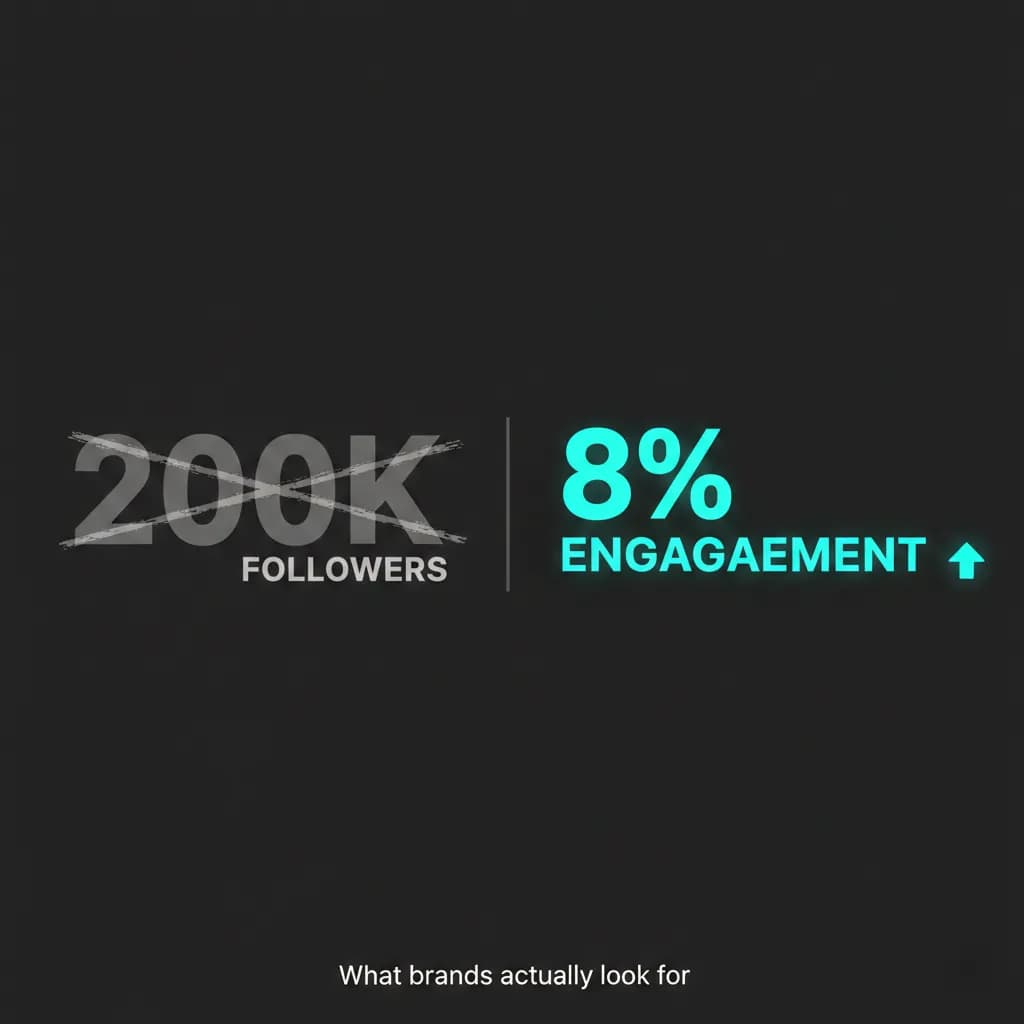
Not about that number. Not the way you think they do.
Right now, a creator with 18K followers is invoicing $2,000 per post while someone with 200K is sending cold pitches that go unanswered. The difference isn't niche, aesthetic, or even content quality. It's that the first creator understands TikTok analytics for brand deals - and the second one is still measuring the wrong things.
This is the full breakdown of what brands actually screen for, what the benchmarks mean, and how to use your data to close more partnerships at higher rates.
The Engagement Rate Threshold That Opens Brand Deals
Every brand conversation starts with one filter: engagement rate.
(likes + comments + shares) ÷ total views × 100
The formula is straightforward but the benchmark has shifted. In 2025, average TikTok engagement sits between 2.5% and 4.9%. If you're at 5%, you're above average. If you're at 10%, you're in the tier that commands premium pricing.
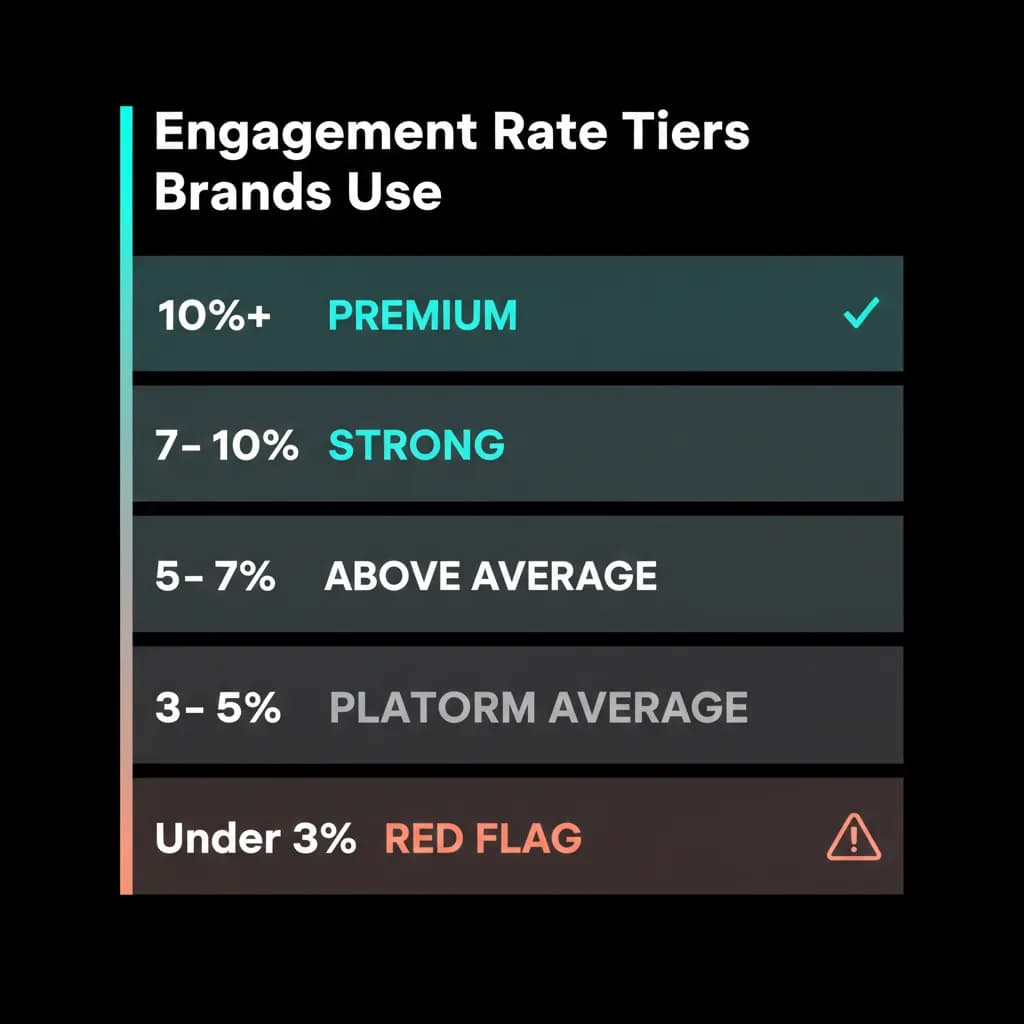
Here's the tier structure brands actually use:
- 10%+ - Premium. Rate negotiations start here.
- 7–10% - Strong performer. Brands will come to the table.
- 5–7% - Above average. You're competitive.
- 3–5% - Platform average. Acceptable, not special.
- Under 3% - Red flag. Unless your reach is massive, this ends most conversations before they start.
The uncomfortable math: a creator with 50K followers at 8% engagement is more valuable than someone with 500K at 1.5%. The first has an audience that responds. The second has a number that looks good in a bio.
Smaller accounts win this metric consistently. Nano-influencers (1K–10K followers) hit engagement rates above 17% at their top tier. This is why micro-influencer campaigns deliver 22x higher conversion than celebrity campaigns - the audience is real and it's paying attention.
What this means in practice: Before you pitch any brand, calculate your engagement rate across your last 10 posts. Not your lifetime average. Not your best video. Your recent average - because that's what brands will verify.
Why Completion Rate Is TikTok's Most Honest Metric
Engagement rate gets you into the conversation. Completion rate determines whether the brand believes you can actually deliver results.
Completion rate measures what percentage of your video people watch all the way through: total watch time ÷ (video length × total views) × 100
The algorithm treats this as its primary ranking signal for the For You Page. A video with 50K views and 75% completion will outperform a video with 500K views and 18% completion in the long run. TikTok doesn't reward reach - it rewards sustained attention.
The benchmarks that matter
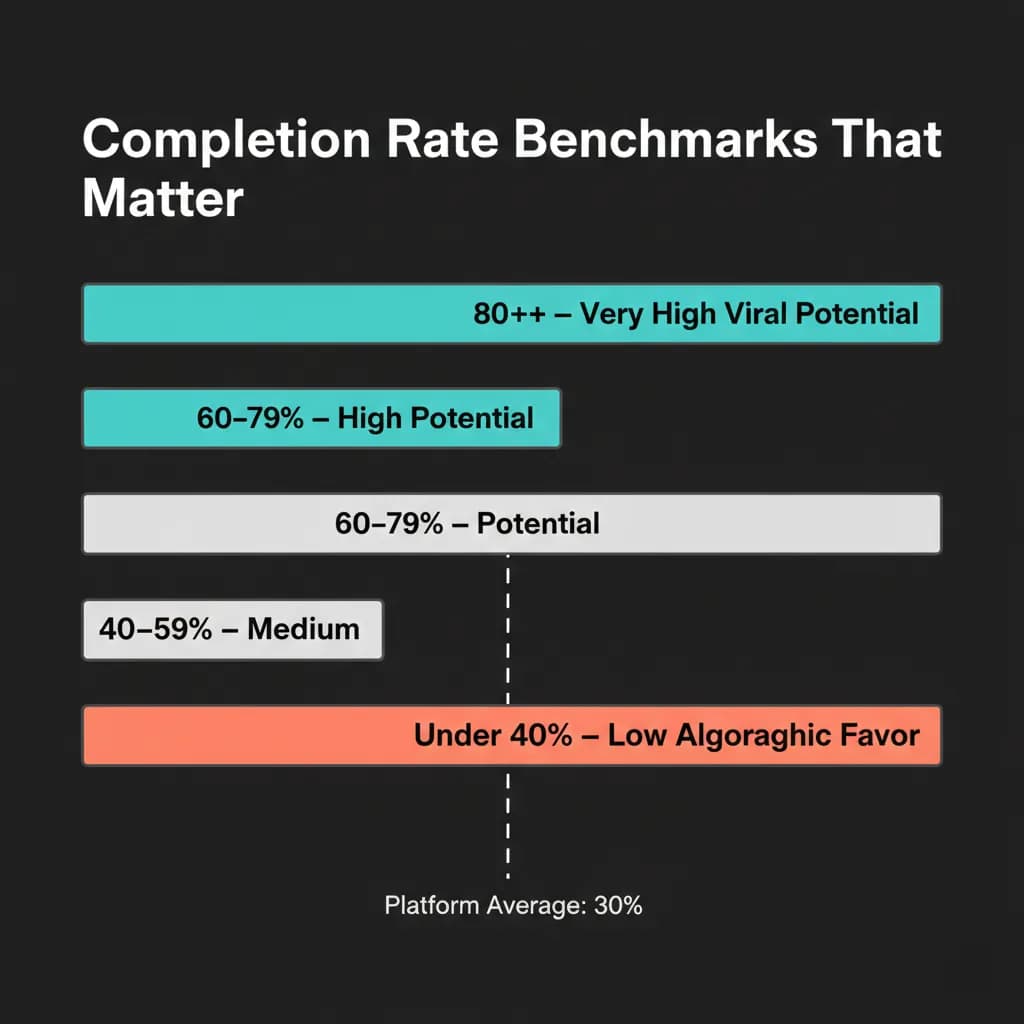
The platform average is around 30%. If you're consistently hitting 60%, you're holding attention at twice the platform norm.
For brand partnerships, this number translates directly. A 30-second video with 70% completion means a brand's product is on screen for 21 seconds - not 5. That's the exposure they're paying for. They know it, and so should you.
What Your Retention Graph Actually Tells Brands
Completion rate is the headline. Retention graphs are the full story.
These graphs show exactly where viewers drop off during your video. A steep cliff at second 4 means your hook isn't working. A gradual slope suggests the middle sags. A flat line to the end means you've cracked your format.
Brands increasingly ask for retention graphs before closing deals.
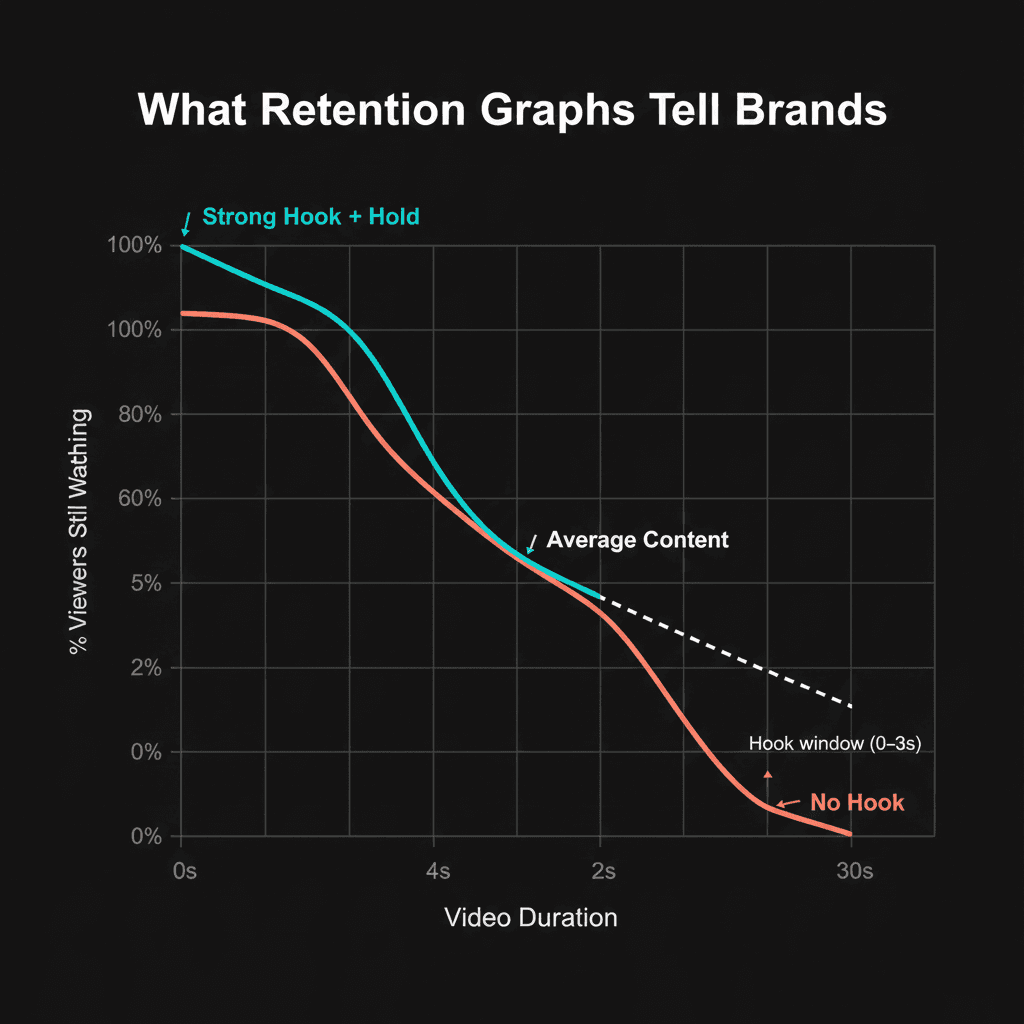
They want to see not just that your audience watched - but where they were still watching when the product appeared on screen.
If you're not reviewing your retention data after every post, you're missing the feedback loop that makes hooks and formats improvable. The first two seconds of your video decide over 70% of your total retention. Videos with a clear hook in the first second get 41% higher retention. A/B testing those first seconds - not the whole video - is the fastest way to move your completion rate.
Average Watch Time and the 8.4-Second Problem
Completion rate and average watch time are related but not the same thing.
A 10-second video at 80% completion (8 seconds watched) wins algorithmically over a 60-second video at 50% completion. But that 60-second video delivered 30 seconds of average watch time - 4x more brand exposure.
The 2025 benchmark: target 50–70% of your video length as average watch time. For a 30-second video, that's 15–20 seconds. The platform average is 8.4 seconds - so if you're consistently clearing that, you're already outperforming most accounts.
What actually moves this number:
- Videos under 10 seconds: 27% more completions
- Adding captions: 32% completion boost
- Face-centered framing: 35% more engagement
- Strong hooks in the first second: 41% higher retention
- Bright, clean lighting: 19% improvement in watch time
These aren't production suggestions. They're levers. If your watch time is below the 50% threshold, pull one lever at a time and measure the change. That's the difference between guessing at improvement and knowing what's working.
Creators who can explain why their top videos performed - the hook format, the pacing, the structure - are creators who can promise consistent delivery. Brands pay for repeatability, not one-time results.
The challenge is that TikTok's native analytics only surfaces 28–60 days of history and gives you no way to compare performance patterns across Instagram or YouTube. If you're posting across platforms and pitching brands who care about multi-platform reach, you need a unified view of your metrics. A cross-platform performance tracker - one that shows engagement rate and saves in one place - gives you key metrics in one view, not just what TikTok surfaces in isolation.
Share Rate: The Virality Signal Brands Pay a Premium For
Of every engagement signal, shares carry the most algorithmic weight - and they're the hardest to earn.
A like takes one tap. A share requires someone to think your content is worth sending to a friend, posting to their story, or saving for later. TikTok's algorithm weights that effort accordingly.
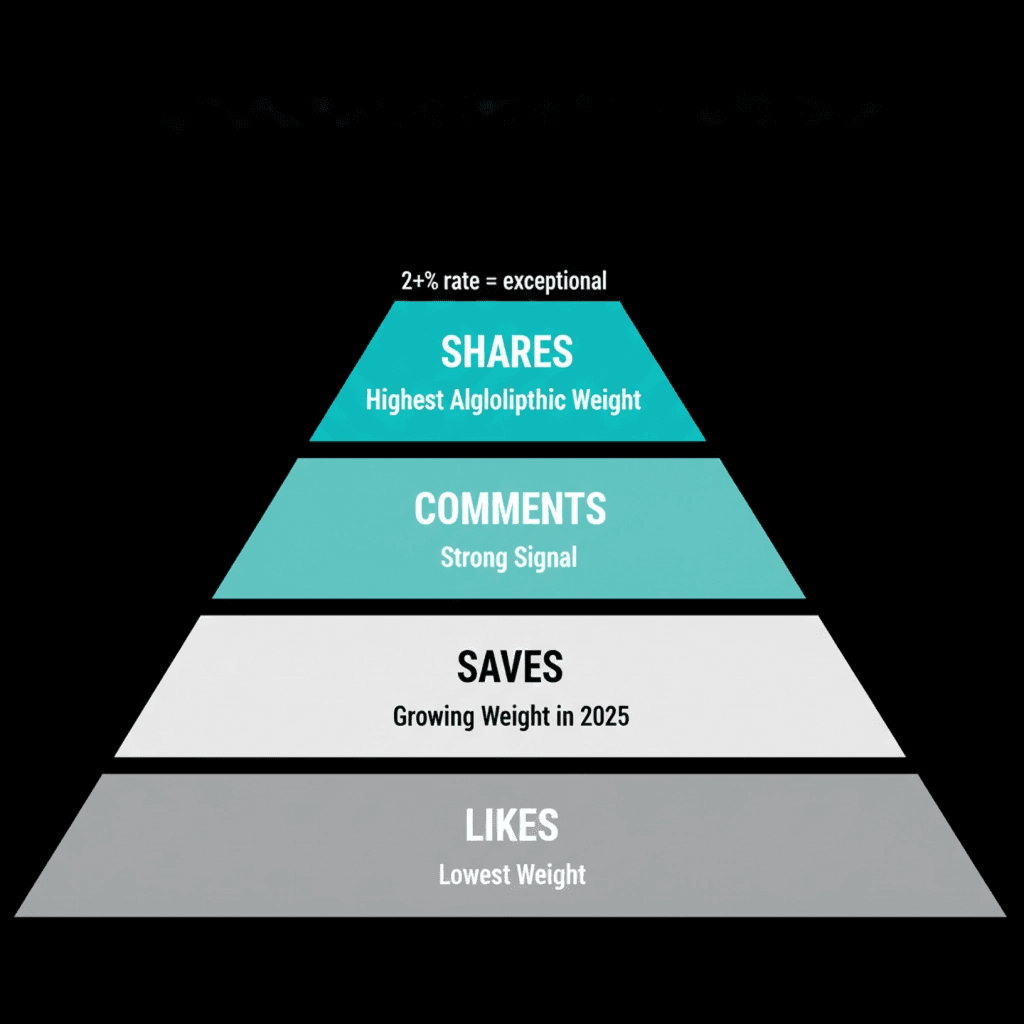
The engagement hierarchy in 2025:
- Shares - highest algorithmic weight
- Comments - strong signal
- Saves - growing weight in 2025
- Likes - lowest weight
A 2%+ share rate is exceptional - that's 2 out of every 100 viewers actively spreading your content. Platform-wide, shares grew 31% in 2025.
A 2%+ share rate is exceptional. That's 2 out of every 100 viewers actively spreading your content. Platform-wide, shares grew 31% in 2025 - but most videos still don't crack 1%.
For brands, shares mean free reach expansion. Every share puts their product in front of a new audience through a trusted recommendation. That's not an impression. That's a referral. It's why brands track share rate specifically on awareness campaigns, not just total views.
Content types that drive this:
- Educational/how-to: 49% more shares than average
- Product demos: 52% more saves
- DIY content: 58% higher save rates
- Transformation content: 2x higher watch time
If you want to move from one-off deals to ongoing partnerships, share rate is the metric that proves your content travels beyond your existing audience. Brands building awareness campaigns pay for that velocity.
Traffic Source: Where Your Views Come From Changes Your Value
Here's a metric most creators skip. Brands do not.
TikTok breaks view sources into distinct categories: For You Page (FYP), Following, Search, Profile, and External. Each one tells a different story about your content's reach.
What brands want to see: 70%+ FYP traffic. That means the algorithm is pushing your content to people who don't already follow you. For awareness campaigns, that's the entire point - reaching new audiences, not just confirming that your existing ones are still watching.
If most of your views come from the Following tab, you have a loyal base. That's valuable. But it also signals the algorithm isn't extending your reach beyond people who already opted in. For brands focused on discovery-layer placement, that's a limitation worth addressing.
Search traffic is a separate opportunity. Over 40% of US users now use TikTok as a search engine. If your content shows up in search results, it has lasting utility - days, weeks, and months after posting. For product reviews, tutorials, and "best of" content (exactly what brand deals often require), search traffic signals that your content works as a discovery vehicle, not just an entertainment feed.
Track this by video, not just overall. Your traffic source breakdown belongs in a media kit that closes deals.
Audience Demographics: The Targeting Proof That Closes Deals
Raw reach doesn't matter if it's reaching the wrong people.
A creator with 20K followers where 78% are women aged 25–34 in the US is more valuable to a direct-to-consumer brand than someone with 200K followers spread across demographics that don't match the buyer profile. Brands know this. Adjust your pitch accordingly.
What to track and surface in every brand conversation:
- Age breakdown - which bracket dominates
- Gender split - especially relevant for consumer brands
- Geographic location - US/UK/Canada audiences command premium rates
- Active times - shows when your audience is actually online
In 2025, TikTok's largest segment is 25–34 (35%+ of users), followed by 18–24 (30%). If a brand is targeting Gen Z and your audience is 80% millennials, no other metric saves that conversation.
Geography affects pricing directly. A creator with 30K US-based followers frequently earns more per post than a creator with 100K followers across lower-value markets. This isn't a quality judgment - it's advertiser demand and purchasing power.
When you pitch, don't just show numbers. Show overlap. "78% of my audience is women 25–34 in the US" lands differently than "I have 50K followers." One is a number. The other is a proof of targeting fit.
How to Turn Your TikTok Analytics Into a Rate Card
Now translate the metrics into money.
Follower-based pricing (baseline, still used):
| Tier | Followers | Typical Rate Per Post |
|---|---|---|
| Nano | 1K - 10K | $50 - $500 |
| Micro | 10K - 100K | $500 - $2,000 |
| Medium | 100K - 500K | $2,000 - $10,000 |
| Macro | 500K - 1M | $10,000 - $20,000 |
| Mega | 1M+ | $20,000 - $50,000+ |
These are starting points, not final numbers.
CPM-based pricing (more accurate)
CPM = (your rate ÷ average views) × 1,000
At $250 charged with 100,000 average views, your CPM is $2.50. Industry range: $3 for nano/micro creators up to $60+ for mega-influencers. Your CPM should scale with your engagement rate.
Engagement rate modifiers:
- 10%+ engagement: add 50–100% to base rate
- High-value niche (finance, B2B, health): add 40–60%
- US-majority audience: premium pricing applies
- Usage rights or exclusivity: add 50–200%

An example that shows why this matters:
Start with a $1,000 base rate (50K followers). Add 30% for 8% engagement ($1,300). Add 40% for finance niche ($1,820). Add 50% for 6-month usage rights. Final rate: $2,730 - for the exact same post.
Understanding which metrics drive value doesn't just help you optimize content. It changes how you negotiate.
The Tools That Give You the Data Brands Ask For
TikTok's native analytics are a starting point, not a system.
Switch to a Creator or Business account and you get an Overview tab, per-video metrics, audience demographics, and traffic source breakdowns. That's genuinely useful.
The limitations are real: only 28–60 days of historical data, no competitive benchmarking, and a 24–48 hour reporting lag. Most importantly, it shows you TikTok in isolation - with no view of how your content performs on Instagram or X.
If you're posting across platforms and pitching brands who evaluate multi-platform reach, you're presenting incomplete data with native analytics alone.
This is the gap a tool like Tracker by Creator Grid addresses directly. Tracker brings your TikTok, Instagram, and YouTube (video) metrics into a single dashboard - engagement rate, saves, and the hook formats that convert - all in one place. Instead of switching between platforms and manually reconciling numbers, you see your performance in one view.
For competitive research - understanding what's working in your niche before you post - the ability to track any public account matters. You can see which formats your top competitors are using and what hooks are landing. That's not just useful for your own content. It's exactly the kind of research that makes your brand pitches sharper: "Here's what's performing in this category, and here's why my approach converts."
The hook and script generator runs on the same pattern data - generating hooks and captions based on proven formats that drive engagement and shares in your niche. For creators spending hours staring at a blank drafts screen, it gives you a starting point calibrated to what works.
Most creators start with native analytics. If you're landing deals consistently above $1,000 and pitching across platforms, a tool that unifies your data pays for itself in a single deal you close with cleaner proof of performance.
Common Mistakes That Kill Brand Opportunities
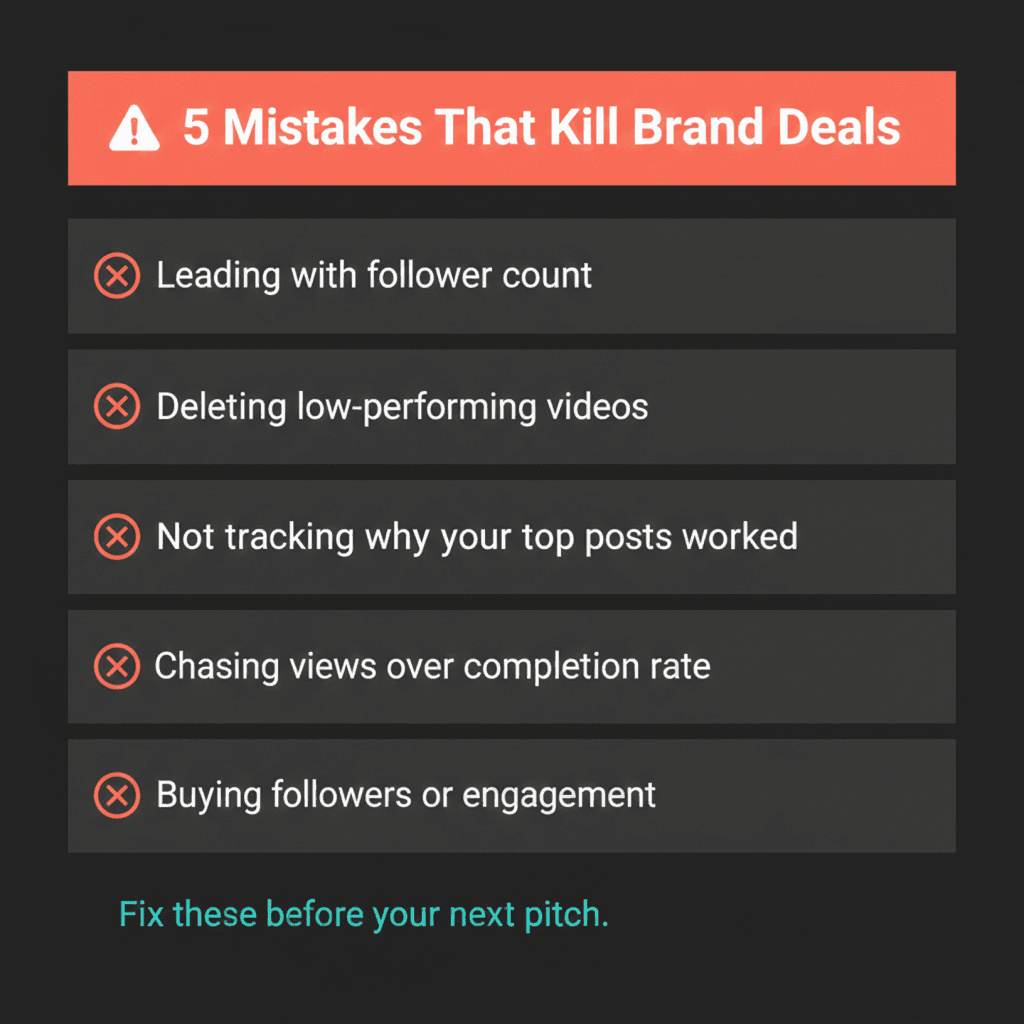
- 1.Leading with follower count. Brands screen for engagement rate first. If your rate is 5%+, lead with that.
- 2.Deleting low-performing videos. One viral hit among 50 mediocre posts signals luck. Consistent 7% engagement across 50 posts signals reliability.
- 3.Not knowing why your top posts worked. Brands pay for repeatability, not one-time results.
- 4.Obsessing over views instead of completion. 10K views at 75% completion beats 100K at 20% in every metric that matters.
- 5.Buying followers or engagement. Brands use audit tools to detect this. One failed audit ends your credibility.
Frequently Asked Questions
What engagement rate do I need to land brand deals on TikTok?+
Most brands set a minimum of 5% for serious consideration. At 7–10%, you're in a strong negotiating position. Premium deals typically go to creators at 10%+. Below 3% without significant reach, most pitches won't advance.
What completion rate should I aim for on TikTok?+
The platform average is approximately 30%. Aim for 60%+ to demonstrate genuine audience engagement. Anything above 80% signals high viral potential and commands premium positioning in brand conversations.
Does follower count matter for brand deals?+
It's a baseline filter - many brands won't consider accounts under 10K. But beyond that threshold, engagement rate, completion rate, and audience demographics determine deal value far more than follower count alone.
How do I show brands my TikTok analytics?+
Screenshot your analytics for the past 30 days. Include engagement rate averaged across your last 10 posts, average views, audience demographics, and your top 3–5 performing videos. Combine these into a media kit you can attach to pitches.
What's the best tool for TikTok creator analytics?+
TikTok's native analytics cover the basics but limit you to 60 days of history with no cross-platform view. For creators managing performance across TikTok, Instagram, and YouTube - especially when preparing brand pitches - a unified dashboard like Tracker by Creator Grid surfaces engagement rate and saves in one place, without manual reconciliation.
Why do brands care about traffic source breakdowns?+
FYP traffic (70%+) signals that the algorithm is actively distributing your content to new audiences - which matters for brand awareness campaigns. Search traffic signals lasting content utility. Both are worth surfacing in pitches as proof of reach beyond your existing follower base.
How do I calculate my CPM for brand negotiations?+
Divide your rate by your average views, then multiply by 1,000. At $500 charged with 100,000 average views, your CPM is $5. Industry range runs $3–$60+, scaling with follower count, engagement rate, and niche value.
The Bottom Line
Brand deals don't go to the biggest accounts. They go to creators who can prove they deliver attention, engagement, and results - consistently.
A small, engaged audience that watches your content to completion and takes action is worth more to a brand than a massive, passive one that scrolls past. The math is clear and it doesn't favor follower counts.
Your TikTok analytics for brand deals aren't just metrics. They're your proof of work. Engagement rate, completion rate, audience demographics - these are what you put in the email, not your follower milestone.
Track the numbers that translate. Present them clearly. Stop optimizing for the metric that looks good at a party but does nothing in a negotiation.
One dashboard for engagement rate and saves across TikTok, Instagram, and YouTube.
Ready to verify your growth?
One dashboard. The metrics that matter. Built for creators who take growth seriously.
- Engagement rate and saves in one dashboard
- TikTok, Instagram & YouTube (video) in a single view
- Hooks & scripts from proven formats